Monday, February 27, 2017
Romania and the Last Frontier Day 7 p m A Quiet Afternoon
Romania and the Last Frontier Day 7 p m A Quiet Afternoon
After the manic morning session with the jackals and eagles, I was feeling in the need for a relatively relaxed afternoon. Another wave of exhaustion had come over me after a very long week of sleep deprivation. I had actually found this trip to Romania much less exhausting than the previous year and more relaxed. On the trip last year, the lack of sleep obviously had an impact on my immune system as I contracted septic tonsillitis as soon I returned to the UK, an illness I have not had since childhood. I think the spluttering person sat next to me on the plane home may have been the source. I think this trip had been more chilled, partly due to it being a repeat visit to the Danube Delta, but also I have tried to take a much more laid back approach to my photography this year. I have grown weary of the degree of ridiculous competitiveness, and the unpleasant undercurrent of deceit that it floats on, which sadly seems to have developed in wildlife photography in recent years. So I made a conscious decision at the start of the year, that I would set out to immerse myself even more with the wildlife and be removed from the pressure of pleasing anyone except myself. It is for this reason I have entered no photography competitions this year and concentrated on spending more time in the company of a few species close to home. It has been refreshing.
Over a pasta lunch we discussed the plans for the afternoon. Rene having seen some of my Bearded Tit photos from the previous day fancied trying to improve on those he had taken when we first arrived. I offered to take him out to try and help.
We picked up on of the electric buggies and headed out in mid afternoon but the light was still too harsh for trying for the acrobatic tits among the reed stems so we decided we would visit one of the hides to pass some time. The one we selected was a small reed clad hide set on the corner of an L-shaped pond which had some posts set in the water in front of it which frequently seemed to be used by terns.


While we were sat that a long thin snake swam across the surface of the channel in front of us before crawling up out on the far bank. After a bit of Google searching we identified it as a Diced Water Snake. Interestingly at home I struggle to get a mobile signal yet everywhere we went in the Danube Delta I seemed to have full mobile and 3G signal!
After a while the sun seemed to be softening down and we decided it was time to go and look for the Bearded Tits. Once again I seemed to find myself photographing Bearded Tits but was more than happy to try and help Rene get some photos and maybe I would get the shot of a male bird I had visioned in my head since arriving. So off we headed down the western track and tried the three places that had been the most productive the previous day. After a bit of effort we managed locate and get some photographs of the birds. Again it was the juveniles that provided most of the camera action.


.jpg)


Rene wanted to head back to the the hotel which brought an end to a relaxed session. As we arrived back at the ranch, we bumped into Zoli. He asked if we wanted to see a Penduline Tit nest he had found that afternoon. Rene declined but I was curious to see this odd structure and so found myself heading back along the tracks to a spot a short-distance from the hotel.
The nest was low in a willow tree at the side of pool and proved very awkward to get an angle on for a clear shot of it. The nest is a truly remarkable structure that looks a bit like a small rugby ball made of cotton wool with a small entrance funnel at the top. After watching it for a short while it began to shake a little and the bandit masked face of the tiny Penduline tit appeared in the entrance.

Go to link Download

Sunday, February 19, 2017
Romania and the Last Frontier Day 6 p m Bearded Tits by Buggy
Romania and the Last Frontier Day 6 p m Bearded Tits by Buggy
After a very good lunch which I cannot recall but know it wasnt fish, I had a brief rest before setting out on the afternoon session. Rene, Paul and Kevin had decided to head off to various hides around Ultima Frontiera and I was going to go out with Zoltan in one of the electric golf buggies, covered with some camouflage scrim net, to have a bit of an explore. However, the main objective for the afternoon was to have another try for Bearded Tits. As we left the hotel around mid-afternoon it was obvious that the Bearded Tits would need to wait until the evening as not only was the light still very harsh but a stiff breeze had developed which would make photographing these tricky birds on reeds even more difficult. Hopefully the wind would calm down with the light later in the day.
We had not gone down the sandy track from the hotel when we came across the first bird, a Hoopoe hunting mole crickets along the verges with the sun high overhead.

We carried on and took a small track eastwards towards the north-eastern corner of the site. Given the conditions I was not too bothered about photography as my thoughts were firmly fixed on Bearded Tits. It was very enjoyable just driving along and seeing what birds were around and if there were any potential photo opportunities that may be worth revisiting the following day. We saw quite a good range of species including Cuckoo, Red-backed Shrike, Common Redstart, Garden Warbler, Penduline Tit, European Roller and Grey-headed Woodpecker.It was also interesting to see some of the flooded forest habitat that formed the northern boundary area of the site which looked a little like a scene from the film Southern Comfort.
Time was passing and we head to the south-western area of the site and try for the Breaded Tits once again. These are actually a very interesting species as they are not actually part of the Tit family and so are now often referred to by their other names of either Bearded Reedling or Parrotbill. It has been placed by taxonomists into the grouping of Parrotbills but is actually a unique song bird species with no other closely related living species.
Small birds which inhabit reed beds such as various warblers, and of course Bearded Tits, as any bird photographer knows can be a very frustrating pursuit. Trying to get a clear photograph of the birds is usually hampered by a single leaf or stem in the wrong place. Often in these situations it is best to concentrate the efforts on the edges of the vegetation where the plants and stems are less dense.
Over the next few hours Zoltan and I worked hard in some very warm conditions at three locations along the western track, trying to get some photographs of the birds. Typically a group of Bearded Tits would appear at the edge of the reed fringing on the far side of a channel adjacent to the track before flying across in fluttering procession to the reeds next to the track. Beyond the difficulties of photographing the glimpses of these hyperactive birds amongst the reeds, they did seem fairly tolerant to our presence although definitely did not like any fast or large movements. This was particularly case with the adult birds.We just used the electric buggy to get us between locations, all the photography was done on foot.
Eventually our persistence was rewarded, particularly with a small group of young birds which spent an extended time, although in reality was probably only a few minutes, at the top of some stems in a relatively sparse part of the reedbed. A selection of photos from the afternoon session are below.
Birds on one side of the track were back lit.


Go to link Download
Thursday, January 5, 2017
Romania and the Last Frontier Day 5 p m To The Last Frontier
Romania and the Last Frontier Day 5 p m To The Last Frontier
After a fish lunch, we packed up our gear. This didnt take me long as I was living out of the suitcase anyway. It was time to wave goodbye to Mila 23. It had been a great start to the trip with so many memorable encounters and wonderful birds. By this stage in our journey I was looking forward to some dry land and actually going for a walk. For the past few days we had been on the boat and there is nowhere to walk by the hotel given that it is on an island and the only place for a stroll is around 20m in either direction on the veranda outside the hotel front door.
We piled our mountain of luggage onto the boat and slipped away downstream from the floating jetty. Our destination was a further two hour journey by boat to the Ukraine border in the far north-eastern corner of the Danube Delta. It seemed like the boat journey went on for ever and we got waved in on the main channel where the border runs by the police for a passport and papers check. The border patrol officer was bemused for a little while by struggling to match Paul with his passport. Since this was issued he had lost a remarkable 70kgs in weight and bears little resemblance to the photograph inside!
We eventually arrived at Ultima Frontiera, which translates to theThe Last Frontier, and following our boat journey it certainly felt a very apt name and that we were a very long way from anywhere. We received a very warm greeting at the dock as we loaded our luggage into two pick-up trucks. Zoltan, the Sakertour guide was also staying with us for the few days and obviously keen to explore the site as we were. I will take a few moments to tell you about Ultima Frontier.The site covers an area of around 1000 ha or 2500 acres and was the location of a former fish farm that was left undisturbed for many years. Below is map of the site to give you some idea of the layout.


The site has only literally just been opened to visiting wildlife photographers and we were to be amongst the first paying guests. Obviously this has advantages and some disadvantages. The main disadvantage is that the hides are new and such facilities usually take time to become established and the set-up refined. On my return I sent Skua Nature some suggestions where refinement of some of the hides could be made.
Once settled into the hotel, we all loaded up into the back of one of the pick-up and were taken by Luca and Zoltan for an evening tour of the site. This was mainly to familairise us with the layout of the huge area and hide locations but obviously the cameras would come with us just in case we came across anything on our travels. I was not expecting to get many photos though with a group of 4 photographers.
My first thoughts as we headed out in the early evening was what an incredible place this was. There were birds everywhere. Bee-eaters gliding around, Hoopoe probing the sandy tracks looking for mole crickets, the loud electric song of Thrush Nightingale from areas of scrub, Great Reed Warbler singing deep within the reedbeds, the list could go on and on. I could grow to like this place very quickly. However, it is not only birds here as there is a good head of mammals that includes wild horses, wild cat, otters and a very special animal which was one of the primary reasons for us heading here - the European Golden Jackal.
We drove around for quite a long time and eventually stopped on the main eastern track to try and photograph some Bearded Tit. The birds were relatively twitchy and are not easy to photograph with their constant fluttering and doing acrobatics around the reeds stems but we managed to get a few photographs of some young birds, my first of this species. I could see myself returning to try again for these over the next couple of days.


It had been a long day and I headed to bed early to recharge my batteries for the following day. I was excited at the prospect of next days of photography at the Last Frontier, particularly as it would start at 5 a.m with trying to photograph our main reason for being here.......the Golden Jackals.
Go to link Download
Wednesday, November 9, 2016
Romania and the Last Frontier Day 3 p m Golden Glow
Romania and the Last Frontier Day 3 p m Golden Glow
A good day was about to get a whole lot better! so expect a good number of photographs below. After the midday break which included fishing around in the vat of soup on the dining table trying to avoid the bits of carp, downloading cards and backing up and a quick siesta, we were assembled on the jetty at 3.pm ready for the afternoon session.
First stop for the afternoon was going to be some Kingfishers. We had tried this spot the previous year with no sign of the birds but I think we had missed them due to our later trip. The strong current pushing down this channel made positioning the boat upstream and into the margin difficult. This was especially the case as the boat need to be perpendicular to the flow. After about 15 minutes the boat was in position and this was the scene before us.

On the left side of the image you can just see the vertical clay bank where the Kingfishers were nesting. After about 20 minutes the male appear with a fish and landed on the perch. With nice even light from some thin cloud overhead, and the dark green swirling waters providing a back drop, the colours of these birds appeared incredibly vivid. A flash of brilliance in this watery landscape. The bird flew into the nest before re-emerging a short while later and disappearing downstream in a flash of electric blue accompanied by the characteristic high pitched penetrating call. Apologies for the background on these photos which have suffered greatly at the hands of jpeg compression but do look great on the originals.


I thought for this part I would post the images by species rather than in any chronological order as to be honest the whole session is a bit of a blur of birds and the sound of whirring camera shutters. At one point we had a Glossy Ibis, Night Heron, and Squacco Heron in a line in front of us and I was sequential going down the line up taking images. An amazing experience to have these photogenic species in front of you with the light improving with each passing moment. Of course the whole process was accompanied by the constant background chorus of frogs just to add the vibrant atmosphere.
I will start with the Glossy Ibis. We managed to photograph this bird the previous year in some fairly poor light. To really appreciate the beautiful colours of these birds they need some sun on them and this particular bird was in superb plumage. A wonderful combination of deep rusty red with a green and bronze metallic sheen across the wings that changed hue with the direction of light. The further the sun fell the more the colours sang out. The bird was striding across the vegetation which it was constantly probing with its curved beak and occasionally pausing to snap up an aquatic morsel. A small selection of photographs are below.

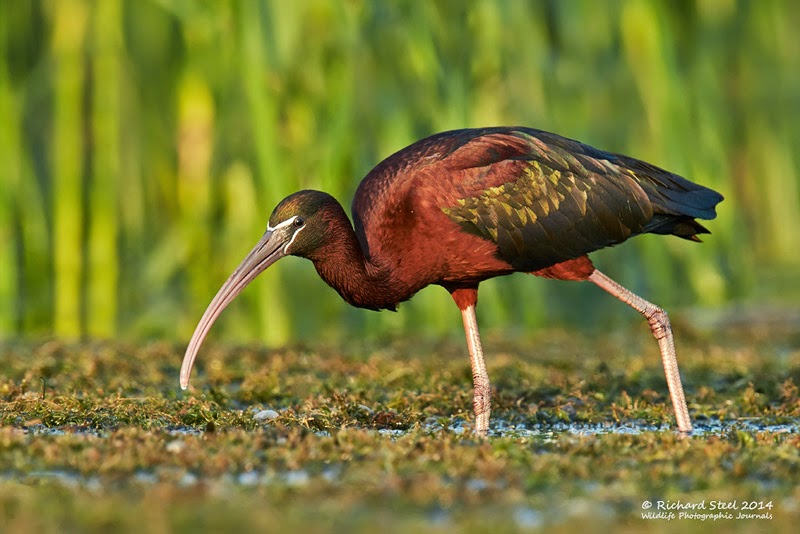


.jpg)


Evening on the Delta from Richard Steel on Vimeo.
This had probably been my favourite session on the Danube Delta to date and one that will remaining in the memory, albeit slightly blurry by it intensity, for a very long time to come. I was already looking forward and wondering what the next day might bring.
Go to link Download